Category: Self-improvement

  • Goal-Focused Attention

    Look Where You Want to Go: How Goal-Focused Attention Fuels Deliberate Practice and Real Achievement

    You have probably heard the advice given to new drivers and motorcycle riders: “Don’t look at the wall. Your car goes where your eyes go.” In racing, this phenomenon is called target fixation. If a driver stares at the barrier they are afraid of hitting, their hands unconsciously steer toward it. If they force their eyes to look at the open track, the gap, or the finish line, the body follows.

    Life works the same way. Whether in your career, your relationships, or your personal growth, the thing you stare at becomes the thing you move toward. If you fixate on obstacles, you will hit them. If you focus on the goal, you give yourself a fighting chance to reach it.

    But there is a deeper reason this matters—one that goes beyond motivation. Focusing on goals rather than obstacles is not just about feeling better. It is the engine behind deliberate practice, the scientifically proven method for achieving mastery. When you shift your attention from problems to outcomes, you stop merely reacting and start training with intention. That is how real achievement happens.

    This article explores why goal-focused attention matters—drawing on the wisdom of trainers and coaches, modern psychology, and literature—and how it directly enhances deliberate practice and measurable achievement. I’ll also share why I believe writing is one of the most powerful tools for locking in this focus.


    1. The Trainer’s Lens: Your Eyes Steer the Vehicle—and the Rep

    Coaches and athletes understand a simple physiological truth: the body follows the eyes. In sports, hesitation comes from looking at what you fear. A basketball player who stares at the defender instead of the hoop is more likely to miss. A public speaker who focuses on the audience’s frowns instead of their message loses their flow.

    The legendary hockey player Wayne Gretzky put it perfectly: “Skate to where the puck is going, not where it has been.” That is a goal-focused mindset. The puck’s current position—the obstacle, the chaos, the noise—is irrelevant. What matters is where you want it to go next.

    Another common coaching phrase is: “Obstacles are what you see when you take your eyes off the goal.” This reframes obstacles not as physical walls blocking you, but as distractions caused by a loss of focus. When you are deeply locked onto a desired outcome—whether it is landing a new client, finishing a marathon, or rebuilding trust in a relationship—the obstacles do not disappear, but they stop dominating your mental screen.

    Why this boosts deliberate practice: Deliberate practice, as defined by researcher Anders Ericsson, requires you to work on specific weaknesses just beyond your current ability. But if you focus on how far you are from perfection—how many mistakes you make, how slow you are, how awkward you feel—you become paralyzed. You practice the fear, not the skill. Goal-focused attention shifts your practice from avoidance to progression. Instead of thinking, “I keep messing up this presentation,” you think, “I am building a clear, confident opening.” You then practice the opening with full attention because your eyes are on the target behavior, not the error.

    When a coach says, “Aim for the bushes” (from the film The Other Guys), the humor hides a truth: if you aim low, you will definitely fail. If you aim high, you might clear the gap. In deliberate practice, that means setting a specific, challenging goal for each session—not just “don’t mess up,” but “deliver the first three lines without filler words.” That is a target you can hit.


    2. The Psychology Lens: What You Focus On Grows—and So Does Your Skill

    Modern psychology and performance science support what coaches have known for decades. The brain has a filtering system called the Reticular Activating System (RAS). It decides what information is important based on what you repeatedly tell it is important. If you constantly think about problems, risks, and failures, your brain will find more evidence of them. If you focus on goals, solutions, and opportunities, your brain will start spotting resources you previously ignored.

    The popular psychological principle “Where attention goes, energy flows” is not just motivational fluff. It reflects how neural pathways strengthen through repeated focus. The more you dwell on a problem, the larger it feels. The more you visualize and articulate a solution, the more your brain works on finding a way forward.

    Carl Jung warned, “What you resist, persists.” In other words, focusing on avoiding a bad outcome still keeps your attention glued to that bad outcome. If your goal is to “not fail,” your brain is still obsessed with failure. But if your goal is to “learn, adapt, and deliver value,” your brain engages creativity instead of fear.

    Psychologist Walter Anderson said, “Focus on the solution, not the problem.” That does not mean ignoring reality. It means giving the majority of your mental energy to what you can build rather than what you fear.

    Why this boosts deliberate practice and achievement: Deliberate practice is hard. It involves failing repeatedly in small ways. If your focus is on the obstacle—“I am not good at this yet, I keep making mistakes, I will never get it”—you will quit. But if your focus is on the goal—“I am one rep closer to mastery, I am improving my form, I am building a skill that will serve me”—you persist through the discomfort. Achievement is rarely about talent. It is about consistent effort over time. Goal-focused attention is what keeps you consistent because it makes the effort feel meaningful instead of punishing.

    In your professional life, solution-focused thinking makes you more valuable in meetings, more resilient in setbacks, and more likely to spot opportunities others miss. In your personal life, it reduces anxiety and rumination. You stop rehearsing worst-case scenarios and start rehearsing your next move. That mental space is where growth happens.


    3. The Literature and Philosophy Lens: The Story You Tell Yourself Becomes the Skill You Build

    Writers and philosophers have long understood that attention shapes identity. The German philosopher Friedrich Nietzsche wrote: “If you gaze long into an abyss, the abyss gazes also into you.” If you stare into darkness, problems, and despair, you eventually become consumed by them. You must look at the stars—the vision, the meaning, the goal—to remain whole.

    Earl Nightingale, a pioneer of personal development, simplified this idea: “You become what you think about most of the time.” That is both a warning and a promise. If your internal narrative is, “I am stuck, I am blocked, the economy is bad, my boss doesn’t like me,” you become the character who is defeated by obstacles. But if your narrative is, “I am moving toward a meaningful goal, and obstacles are just plot twists,” you become the character who grows.

    The French playwright Molière wrote, “The greater the obstacle, the more glory in overcoming it.” This is a subtle but powerful reframe. The obstacle is not a stop sign; it is the raw material of the goal. The challenge is not separate from the achievement—it is what makes the achievement meaningful.

    Why this matters for deliberate practice: Deliberate practice requires you to see yourself as a work in progress, not a finished product. If your story is “I am not talented, I am not disciplined, I always fail,” you will avoid practice because every session feels like evidence of your inadequacy. But if your story is “I am becoming someone who can do this,” every practice session becomes a chapter in a growth arc. You start to see obstacles as plot points, not endings. You keep practicing because you are invested in the character you are becoming.


    Why Writing Helps Lock In This Focus—and Accelerate Achievement

    I agree strongly that writing is one of the most effective ways to train your mind to focus on goals rather than obstacles. Writing forces you to externalize your thoughts. When fears and obstacles stay inside your head, they feel huge, vague, and overwhelming. The moment you write them down, they become concrete—and often smaller than you imagined. You can then intentionally redirect your attention.

    Here are four writing practices that help build positive mental space and fuel deliberate practice:

    1. The Brain Dump and Redirection: Write down every obstacle, worry, and fear you have. Get it out of your head. Then, on the next page, write down three goals and the first small step for each. You have just moved your attention from the wall to the open track.
    2. Pre-Practice Scripting: Before a deliberate practice session, write down the specific skill you are working on and the exact outcome you want. For example, “Today I am practicing the first five minutes of my presentation. By the end, I will deliver the opening without filler words.” This focuses your practice on the goal, not the general fear of public speaking.
    3. Post-Practice Reflection: After the session, write down what improved and what you will work on next. This trains your brain to see progress, which is essential for staying motivated through the hard parts of deliberate practice.
    4. The Obstacle Reframe: When you hit a wall, write it down, then answer this question: “What is this obstacle asking me to learn, change, or become?” That keeps your eyes on the destination while still respecting the journey.

    Writing gives you distance. It turns a messy mental storm into a clear map. It helps you see that the obstacle is not the whole picture—it is just one item on the page, while the goal is still there waiting. More importantly, writing makes your practice deliberate. You stop going through the motions and start training with intention. That is where achievement lives.


    For this reason, I always carry with me a notebook—as shown in the attached image—to write and ponder about actionable tasks.

    Writing bridges the gap between passive intention and deliberate execution. When goals and obstacles remain locked inside your head, they feel overwhelming and abstract. Putting pen to paper externalizes those thoughts, transforming vague worries into concrete, manageable problems.

    This notebook serves as a physical steering wheel for the mind. Instead of staring at the barriers mentioned in the article, jotting down actionable tasks allows you to:

    • Isolate the target: Strip away emotional noise and define the exact skill, metric, or outcome you are aiming for in your next practice session.
    • Break down the friction: Convert a daunting overarching goal into small, sequential steps that prevent paralysis and invite immediate action.
    • Maintain forward momentum: Use daily written reflections to shift your focus away from past mistakes and directly onto the open track ahead.

    Carrying a notebook ensures that goal-focused attention is not just a theoretical concept you read about, but a daily, tactile habit that actively fuels deliberate practice and real achievement.


    Conclusion

    You cannot always control the obstacles that appear in your path. But you can always control where you point your attention. Trainers show us that the body follows the eyes. Psychology shows us that the brain follows our dominant thoughts. Literature shows us that the story we tell ourselves becomes the life we live.

    When you focus on goals rather than obstacles, you do more than feel better. You practice better. You persist longer. You achieve more. Deliberate practice is not about ignoring your weaknesses; it is about shifting your focus from what is wrong to what you are building. That shift creates the mental space needed to improve.

    If you want more positive mental space and greater achievement—both personally and professionally—stop staring at the wall. Look at the gap. Look at the finish line. Look at the person you want to become.

    And if you struggle to do that, start writing. Put the fear on paper, then turn the page and write the goal. The simple act of writing may be the steering wheel you need to get your mind back on the road.

  • Adaptive planning

    Adaptive planning

    For a healthy work-life balance as a freelancer, I’ve adopted a more flexible work schedule over the past six to seven months.


    Instead of working a strict 9-to-5—which limited my freedom to engage in other essential activities—I’ve gradually implemented a much more supple schedule. This doesn’t mean I work less; I put in the same number of hours, but with better quality in both my work and my life.


    I made the decision to become more flexible with my working hours because there are other activities—socializing, cooking, fishing, praying at the mosque, reading ebooks—that are essential to my growth on both a personal and professional level.


    In truth, a rigid plan led to more stress, a lower quality of life, and limited social connections. In other words, my quality of life suffered.


    After six months of adapting this more flexible schedule, I can clearly see the difference: I’m more relaxed, and I enjoy both my life and my work much more. I engage in a wider variety of activities and avoid the tunnel vision that comes with hyperfocusing on work productivity and sports.


    Unfortunately, that hyperfocus proved counterproductive—it left me stressed at work and dealing with overuse injuries.
    Looking at the long term, adopting a “consistency over intensity” approach is much wiser.

    Even though I’m capable of maintaining intensity for years, doing so means ignoring other important aspects of life.

    This concept is captured beautifully in Japanese culture by the term Shokunin—a deep commitment to one’s craft, but also to community and self. Shokunin embodies a philosophy of lifelong learning and humility.

    Adaptive Planning in Practice


    I use the Planify app to organize my work and create a funnel for both my personal and professional projects. I also silence all notifications on my smartphone and avoid answering emails during deep work sessions.


    I limit myself to reading only two ebooks at a time: one for focused work-related training, and one for general culture.


    Instead of time blocking, I use theme days. Rather than scheduling every hour of my day, I dedicate entire days to specific types of work—like client projects, admin tasks, or deep learning.

    This gives me the flexibility to work when I’m most productive while ensuring important categories don’t get neglected. Theme days reduce the mental friction of constantly switching between completely different types of tasks throughout a single day.


    I maintain a backlog for my pending projects. My backlog serves as a holding pen for every idea, task, and project that crosses my mind, keeping them organized and visible without cluttering my immediate focus.

    During my weekly reviews, I pull items from this backlog into active work, ensuring nothing falls through the cracks while maintaining control over my workload. This system gives me confidence that I’m not forgetting anything, even when I’m fully immersed in client work or taking time for fishing and prayer.


    Paid projects always take priority. I pause all training and open source contributions until I finish paying work. This is essential because I may receive several freelance gigs in quick succession. If I’m contributing to FOSS projects at the same time, I might either turn down paid work or risk missing deadlines. Context switching has a cost—for this reason, I also batch similar tasks together.


    Adaptive planning is also about managing energy, not just time. This approach supports sustainable, high-quality work and a better quality of life overall. For example, when I take on a large, complex project and work intensively for weeks, I give myself a few days of rest afterward. I do the same even after a small but energy draining project.


    This only works if I trust myself to complete work in the right time, rather than a prescribed time. Since shifting to this philosophy, I’ve delivered every project on time, earned promotions to senior roles, and attracted more clients.

    How I Did This?


    I studied books on Personal Knowledge Management (PKM) and implemented weekly, monthly, and yearly reviews. I’ve also been taking consistent notes. This practice supports metacognition and helps me organize both my life and my work.


    Rather than following the “10,000 hours” rule for mastery, I’ve embraced the “10,000 experiments” rule for life design. Every adjustment I make—reading only two books, pausing FOSS work during client projects, scheduling time for fishing—is an experiment. I observe the results, learn, and iterate. Adaptive planning is a mindset of continuous experimentation, not a fixed system.


    This approach will help me evolve not just as a professional, but as a person.

  • Gaining practical knowledge while experimenting

    Gaining practical knowledge while experimenting

    Things are working as planned as I have noted before in this previous post that I spend much time reading and I was more of a theoretical person then practical. I described myself as a professional student to some extent.

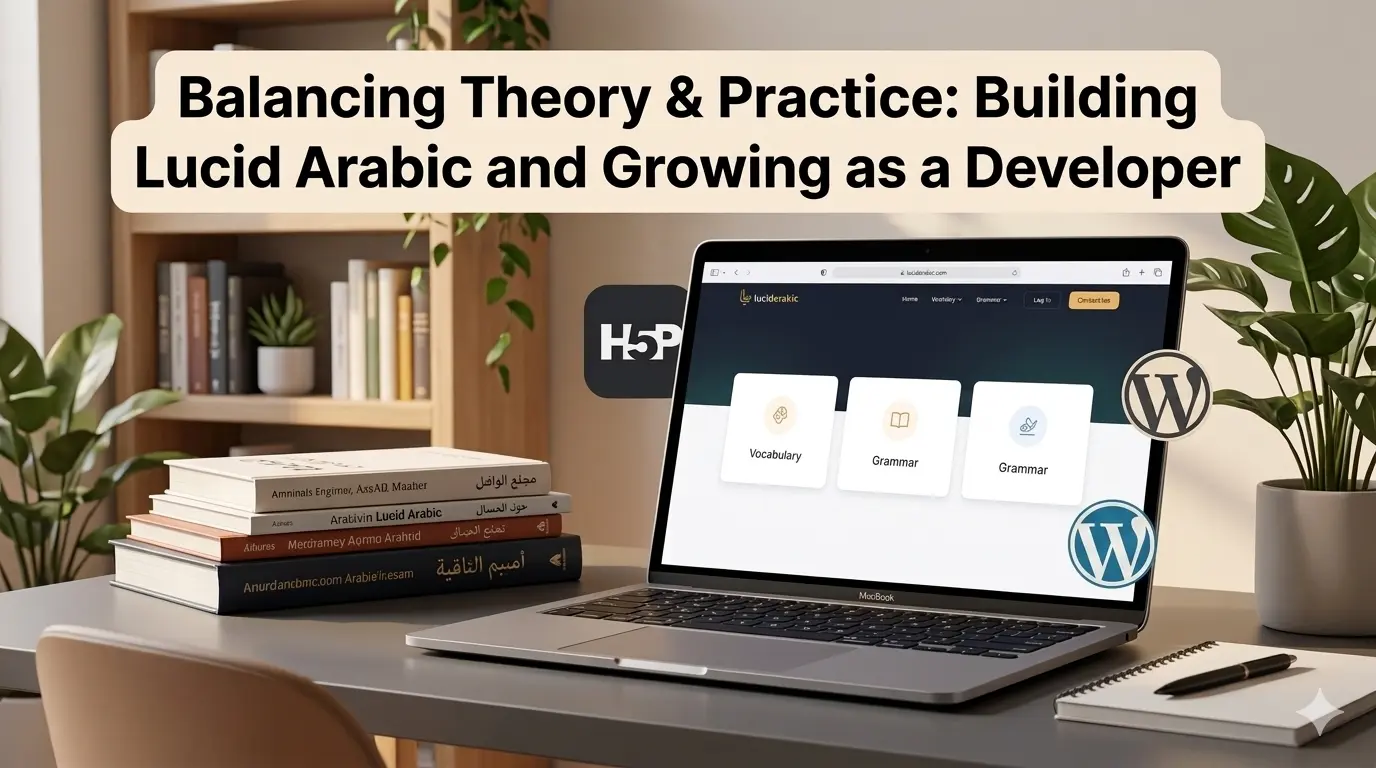
    In my free-time, I contribute to open-source projects on WordPress.org and outside the WordPress ecosystem as well. I have established a new online business, lucidarabic.com, not staminacode.com, which is now defunct.

    This new online business focuses on providing various language services, however, I am pivoting to mainly focus on teaching Arabic language and adding content about Arabic culture.

    However, getting back to the growing more of a practical person this online business is teaching me new firsthand experience and reinforcing techniques and knowledge learnt from books.

    The new Lucid Arabic website, is gaining more visitors especially after about a year. I have created many Arabic vocabulary lessons and I published them. However, I have created more than 60 Arabic grammar practice exercises and around 30 Arabic grammar lessons as well, but did not publish these yet.


    Why not published yet?


    The Lucid Arabic site structure needs to change, such as a section for:

    – Vocabulary for beginners

    – Vocabulary for intermediates

    – Vocabulary for advanced

    – Grammar for beginners

    – Grammar for intermediates

    – Grammar for advanced

    For a well structured site that is easy to navigate and to build it in a SEO optimized way, there is some work that needs to be done to redirect the old vocabulary lessons. There are many plugins available for this purpose. The URLs of each sections should be well thought of.

    In regards to the quizzes and tests, I was pleased to find a 100% free and open-source plugin named H5P that I am using to create practice exercises. These exercises need to be linked to each section, vocabulary and grammar.

    Also, I’ve also thought about creating pronunciation audio recording. However, first and foremost, it’s more strategic to finish 50 grammar lessons at least and the related practice exercises.

    Growing as a localization specialist & developer

    Since, I am happy and grateful to find the H5P plugin which suits my needs, I have localized it to Arabic, this is my way to give back and thank the community for their contribution building and maintaining H5P.

    Furthermore, I am also tinkering and studying redirection plugins to grow as a WordPress plugin developer. For this, I use WordPress documentation, local server and various AI tools to better understand the plugin code.

    Conclusion

    Experimenting with a WordPress website to start a new business and to gain more knowledge is a nurturing experience, Google Analytics shows a growth on my site even though I only publish one lesson a week. Further, analysis of the data will support growing the traffic. Consequently, my plan creating high quality courses and tests looks promising. Finally, this goes hand in hand with gaining more technical programming skills in PHP and JS.

  • My Journey in Technical Translations, Localization, and Open-Source Contributions

    Introduction

    As someone passionate about technical translations, I have always been drawn to two fields: life sciences and technology. While both areas interest me, technology has become my primary focus due to its accessibility and the numerous opportunities it offers. Within the realm of technology, I have developed a strong interest in localization and internationalization, which enable people from diverse linguistic and cultural backgrounds to access and engage with technology. I believe that localization and internationalization are essential components of creating inclusive and user-friendly technology.

    Getting Started with Coding and Open-Source Contributions

    In 2017, I began contributing to free and open-source software (FOSS) projects as a translator. My initial projects included translating WordPress themes and plugins, as well as the VLC media player. This experience led to my recruitment by a French company as an Arabic software localization specialist. Although my contributions eventually became sponsored, I continued to work on various projects in my free time. Contributing to FOSS projects has not only helped me develop my technical skills but also given me the opportunity to connect with other developers and enthusiasts from around the world.

    Personal Projects and Learning Experiences

    In addition to my professional work, I have been investing time in learning Japanese and reading non-fiction books. I have also been working on improving my software engineering skills, with a focus on creating mobile apps and WordPress themes. One of my personal projects involved building a Flutter app, which taught me a great deal about practical coding and debugging. Although I faced numerous challenges and setbacks during the development process, I was able to gain valuable insights into the app development process. After investing over 250 hours in coding and debugging, I was able to fix most of the errors, but I still encountered a runtime error. Despite this setback, I was able to learn more about debugging and troubleshooting, which has been invaluable in my future projects.

    Revisiting FOSS Contributions

    Recently, I received emails from WordPress reminding me to update my profile and highlight my contributions. This prompted me to re-evaluate the importance of FOSS contributions and how they can enhance my skills as a localization engineer. To further develop my expertise, I obtained three new certificates from Lokalise related to software localization. These certificates have given me a deeper understanding of the localization process and have equipped me with the skills necessary to tackle complex localization projects.

    Benefits of FOSS Contributions

    Contributing to FOSS projects has numerous benefits. For instance, it allows me to practice my localization skills, gain in-depth knowledge of various software projects, and connect with other enthusiasts and translation managers. Moreover, contributing to FOSS projects enables me to give back to the community and develop my skills in using different tools and technologies. By contributing to FOSS projects, I am not only improving my own skills but also helping to create technology that is more accessible and inclusive.

    WordPress Contributions

    My contributions to WordPress have been particularly rewarding. By translating plugins and themes, I have been able to create a comprehensive glossary of technical terms. This glossary has not only improved my own knowledge but also helped others in the WordPress community. Furthermore, my contributions have been publicly recognized, allowing me to connect with other WordPress enthusiasts and receive feedback on my work. I believe that contributing to WordPress has been an invaluable experience, as it has given me the opportunity to develop my skills, connect with others, and give back to the community.

    H5P Contributions

    One of the most fulfilling projects I have contributed to is H5P, a free and open-source learning management system (LMS). As the translator editor for the Arabic language, I have been able to translate the entire app. This contribution has not only helped me develop my localization skills but also enabled Arabic-speaking users to access and utilize the H5P platform. I believe that contributing to projects like H5P is essential, as it promotes digital inclusivity and bridges the gap between technology and diverse linguistic communities. By contributing to H5P, I have been able to make a positive impact on the lives of others and help create a more inclusive and equitable technological landscape.

    AppFlowy Contributions

    In addition to my work on WordPress and H5P, I have also contributed to AppFlowy, a free and open-source note-taking and knowledge management app. By translating the app and contributing to its documentation, I have been able to develop my skills in using new tools and technologies, such as Weblate and inlang. Moreover, contributing to AppFlowy has allowed me to connect with other business owners, developers and enthusiasts, further expanding my network and knowledge. I am excited to continue contributing to AppFlowy and help create a more inclusive and user-friendly app.

    Conclusion

    In conclusion, my journey in technical translations, localization, and open-source contributions has been incredibly rewarding. Through my experiences, I have been able to acquire practical knowledge, develop my skills, and connect with like-minded individuals. As I continue on this path, I am excited to see where it will lead and how I can further contribute to the FOSS community, promoting digital inclusivity and bridging the gap between technology and diverse linguistic communities. I believe that my experiences have not only helped me grow as a professional but also given me a sense of purpose and fulfillment.

    Future Plans and Goals

    As I move forward, I plan to continue contributing to FOSS projects, expanding my skills and knowledge in localization, internationalization, and software development. I also hope to mentor others who are interested in pursuing careers in technical translations and localization. Furthermore, I aim to create my own open-source projects, leveraging my skills and expertise to create technology that is accessible and inclusive.

    Final Thoughts

    In closing, I would like to emphasize the importance of community involvement and giving back to the FOSS community. By contributing to FOSS projects, we not only improve our own skills and knowledge but also help create technology that is more accessible, inclusive, and equitable. I encourage others to join me on this journey, and together, let’s create a more inclusive and technologically advanced world.

  • Implementing Deliberate practice for my language services

    Implementing Deliberate practice for my language services

    To achieve and maintain a high level of expertise as a translator/linguist, I am committed to deliberate practice. I have been working as a full-time freelance translator since 2014. I work with direct clients and LSPs from all over the world. Over the years I have consistently over-delivered, become a top-rated and preferred translator for various large translation agencies, and even get bonuses for completing challenging projects well and on time.

    What is deliberate practice?

    It is a focused approach to skill improvement to reach a high level of expertise. In this article, I will discuss deliberate practice dedicated to language skills, without delving into my other areas of interest much.

    Goal-oriented approach to improving language and business skills

    As a freelance linguist, my job is not only translating, reviewing, editing, etc, but also doing marketing, generating invoices, networking, negotiating, and so forth. In short, language and business skills.

    Language skills and technical jargon:


    To perfect my language skills related to the language industry, I read daily e-books related to my specialties. To structure my language training, I use a habit tracker and a timer to log how many minutes I study weekly. For my specialty related to health, I log at least 500 minutes a week of reading and to a lesser extent listening to podcasts.
    The habit app I use is free of charge with no ads, you can find this app here.

    Besides, reading about my specialism (medical and life sciences) I also blog on this website and I take notes voraciously on Google Docs. I use dictionaries and thesauri for practically every word I want to understand or discover its synonyms.

    Regarding my tech and IT specialism, I use the Linux operating system, I create websites myself, and I know the basics of web development including HTML, CSS, JS, and PHP. Moreover, as I noted in a previous article, I am studying Dart/Flutter to build a mobile app.

    Regularly engaging with complex concepts related to medicine, life sciences, and software, enables me to understand advanced technical language and accurately translate and review specialized terminology.

    Nurturing business acumen

    Online visibility and presence
    Having a well-designed professional website and an active blog for my freelance business is essential for highlighting my skills and express myself. In fact, the actual website is the fifth or sixth iteration. I built this website all by myself and I remember that the first two did not look good.

    With a professional website, I also acquired a professional email “linguist@fakhriazzouz.com” for sure it looks much more serious than a Gmail, Yahoo, or live email address.

    Business development

    I look for new business opportunities and grow sales, by contacting LSPs and offering my services. I negotiate my rates and offer a unique value proposition. I have all the required data ready to be shared with new business partners for faster inboarding. I follow language industry news and trends to identify new emerging opportunities, and develop new skills or learn new tools.

    Deliberate practice for language and business

    1- Focus and attention: I do not multitask, I only monotask. I schedule specific days for each project, that is to say I dedicated specific time slot for language skills maintenance and development, and devote time for business development or other preplanned tasks. For each task I pay attention to details and ask myself actively how I can do the task faster and better. I push the limit gradually to improve continuously.

    2- Knowledge management: I always take notes, whether using Google Docs, Google Keep, or a voice recorder when on the go. More importantly I review my notes in a very regular and consistent way. I backup important data on specific dates of the year. I do weekly, monthly, and yearly review for all aspects of my business. This help me strategize and change tactics when necessary, treamline my work and manage the knowledge I am amassing by my extensive reading and training.

    3- I strategize for the long term: Deliberate practice requires sustained effort on the long run; becoming an elite expert is a marathon, not a sprint.Hence, I focus on monotasking, planning, knowledge management, extensive reading, and note-taking, without forgetting about intrinsic motivation.

    4- Health & well being
    Furthermore, a healthy life style is essential to have a healthy body and mind to be able to deliver great results. In fact, starting from May 2024 I leveled up my physical training with more intensive exercising using weight and cycling. I log my progress and work on incremental improvement to become athletic. I have good sleep hygiene and flourishing spiritual life as a Muslim.

    Conclusion

    In a never-ending quest for excellence, deliberate practice itself can be improved, as I have lately discovered that there is a science for expertise. This opens the door to a whole new path for improvement.
    In Arabic, we have a related saying by Imam Gazali قال الإمام الغزالي: «العلم إذا أعطيته كلك أعطاك بعضه وإذا أعطيته بعضك لم يعطك شيئاً فعليك أن تفني حياتك حتى تتعلم», it means that: “if you invest with all you have in knowledge you will get only some results and if you invest little you will get nothing, for this you have to dedicate your life to learn”.