For a healthy work-life balance as a freelancer, I’ve adopted a more flexible work schedule over the past six to seven months.
Instead of working a strict 9-to-5—which limited my freedom to engage in other essential activities—I’ve gradually implemented a much more supple schedule. This doesn’t mean I work less; I put in the same number of hours, but with better quality in both my work and my life.
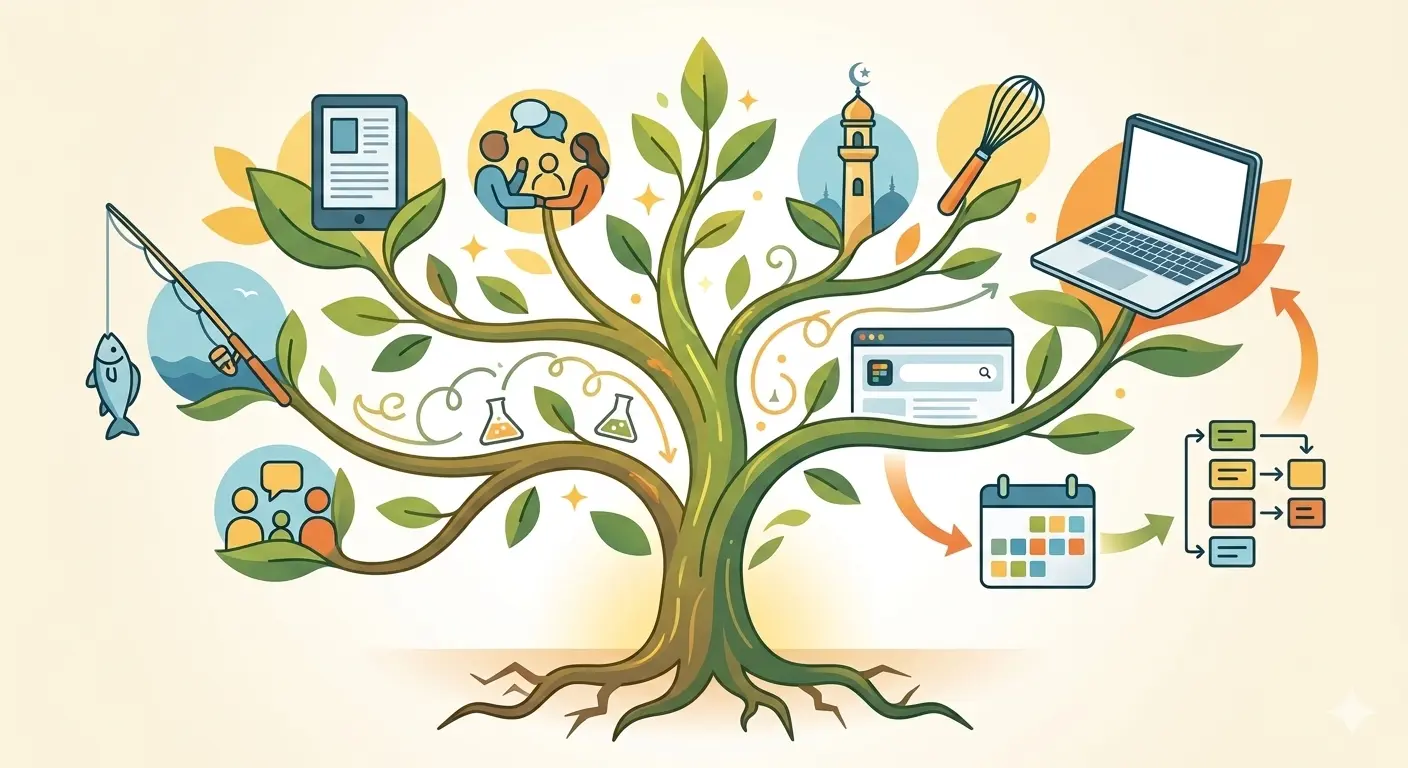
I made the decision to become more flexible with my working hours because there are other activities—socializing, cooking, fishing, praying at the mosque, reading ebooks—that are essential to my growth on both a personal and professional level.
In truth, a rigid plan led to more stress, a lower quality of life, and limited social connections. In other words, my quality of life suffered.
After six months of adapting this more flexible schedule, I can clearly see the difference: I’m more relaxed, and I enjoy both my life and my work much more. I engage in a wider variety of activities and avoid the tunnel vision that comes with hyperfocusing on work productivity and sports.
Unfortunately, that hyperfocus proved counterproductive—it left me stressed at work and dealing with overuse injuries.
Looking at the long term, adopting a “consistency over intensity” approach is much wiser.
Even though I’m capable of maintaining intensity for years, doing so means ignoring other important aspects of life.
This concept is captured beautifully in Japanese culture by the term Shokunin—a deep commitment to one’s craft, but also to community and self. Shokunin embodies a philosophy of lifelong learning and humility.
Adaptive Planning in Practice
I use the Planify app to organize my work and create a funnel for both my personal and professional projects. I also silence all notifications on my smartphone and avoid answering emails during deep work sessions.
I limit myself to reading only two ebooks at a time: one for focused work-related training, and one for general culture.
Instead of time blocking, I use theme days. Rather than scheduling every hour of my day, I dedicate entire days to specific types of work—like client projects, admin tasks, or deep learning.
This gives me the flexibility to work when I’m most productive while ensuring important categories don’t get neglected. Theme days reduce the mental friction of constantly switching between completely different types of tasks throughout a single day.
I maintain a backlog for my pending projects. My backlog serves as a holding pen for every idea, task, and project that crosses my mind, keeping them organized and visible without cluttering my immediate focus.
During my weekly reviews, I pull items from this backlog into active work, ensuring nothing falls through the cracks while maintaining control over my workload. This system gives me confidence that I’m not forgetting anything, even when I’m fully immersed in client work or taking time for fishing and prayer.
Paid projects always take priority. I pause all training and open source contributions until I finish paying work. This is essential because I may receive several freelance gigs in quick succession. If I’m contributing to FOSS projects at the same time, I might either turn down paid work or risk missing deadlines. Context switching has a cost—for this reason, I also batch similar tasks together.
Adaptive planning is also about managing energy, not just time. This approach supports sustainable, high-quality work and a better quality of life overall. For example, when I take on a large, complex project and work intensively for weeks, I give myself a few days of rest afterward. I do the same even after a small but energy draining project.
This only works if I trust myself to complete work in the right time, rather than a prescribed time. Since shifting to this philosophy, I’ve delivered every project on time, earned promotions to senior roles, and attracted more clients.
How I Did This?
I studied books on Personal Knowledge Management (PKM) and implemented weekly, monthly, and yearly reviews. I’ve also been taking consistent notes. This practice supports metacognition and helps me organize both my life and my work.
Rather than following the “10,000 hours” rule for mastery, I’ve embraced the “10,000 experiments” rule for life design. Every adjustment I make—reading only two books, pausing FOSS work during client projects, scheduling time for fishing—is an experiment. I observe the results, learn, and iterate. Adaptive planning is a mindset of continuous experimentation, not a fixed system.
This approach will help me evolve not just as a professional, but as a person.